The Sidewalk Is Watching: Why the City Is Alleycat's Only Real Antagonist
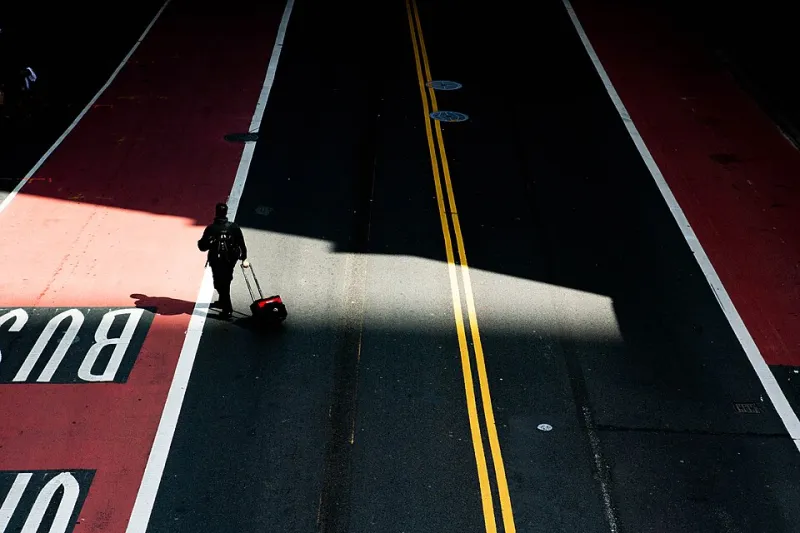
Photo: Anthony Quintano, CC BY 2.0, via Wikimedia Commons
There’s a temptation, after a first viewing of Alleycat, to argue about who did it. Which of the nine was lying about the diner. Whether the cat was a witness or an accomplice. It’s a fun argument. It’s also a distraction.
The film doesn’t have a villain. It has a city.
The Alley Has Rules
Watch the alley scenes again and notice how little anyone controls. The characters don’t decide to meet there; they’re routed there — by a locked gate, a broken streetlight, a cop car idling at the corner. The alley is a room with a landlord. It decides who gets to stand where, how loud you can talk, how long you can stay before a window opens above you and somebody tells you to move along.
That’s not atmosphere. That’s authority. The alley never speaks, but it issues a verdict in basically every scene: not here, not like that, not for long.
And it isn’t a coincidence that the film keeps finding a camera in the frame — a bodega’s fisheye, a doorbell unit, a traffic light cam blinking red in the corner of the shot. Nine lives, one night, and a dozen lenses that belong to nobody we meet. The city is the only character with a complete record of what happened.
The Diner Is a Panopticon With Pie
The diner is the opposite trick. It’s warm, loud, fluorescent, and full of regulars who have seen everything and will absolutely mention it. It’s the most socially surveilled space in the movie. Everybody has a table. Everybody knows whose table it is. Secrets don’t get kept in the diner; they get managed, portioned out to whoever’s already sitting close enough to overhear.
That’s why the most brutal moments in the film happen over a menu. Not because anyone raises their voice — because the room makes silence expensive. Somebody has to say something before the coffee gets refilled a third time.
Gentrification Is the Weather
Here’s the part that reads differently in 2026 than it might have five years ago. The alley is a leftover space — the stuff developers haven’t gotten to yet. The diner is a holdout. The bar is on a block where the awning is older than the building’s current rent. Nobody in Alleycat monologues about any of this. It’s just the air they breathe, and the reason every character is running a low-grade calculation about how much longer they get to stay.
Gentrification functions in the film the way weather functions in a survival story. It isn’t the enemy. It’s the condition. It’s why the stakes feel enormous even though nothing explodes. Losing the lease and losing the argument turn out to be the same sentence.
Noise as Enforcement
Sound does the city’s dirty work too. The saxophone two blocks over is beautiful and it never stops. Traffic swallows a confession. A garbage truck arrives on cue to make the most important line in the movie half-audible. The city has a noise ordinance and it enforces it against exactly the people who need to be heard.
There’s a reading of the ending — I won’t spoil it, but you’ll know the shot — where the point isn’t who was right. It’s that the street is already resetting itself. By morning, the block will look like nothing happened in it, because that’s what blocks do.
The Counterargument
Fair pushback: calling the city a villain risks letting the human characters off the hook. They lie. They choose. They keep secrets that cost other people money and sleep. A movie where the environment is the antagonist can slide into an excuse, and Alleycat is smarter than that — mostly.
But the reason the “who did it” debate stays so lively is that the movie keeps handing responsibility to something bigger and more permanent than any one person. Every character is guilty of something small. The city is guilty of the structure that makes the small thing matter.
Nine Lives, No Verdict
What I keep coming back to is the cat, who is the only creature in the film fully adapted to the environment. It isn’t innocent. It isn’t guilty. It just knows where the cameras are and where the food is, and it moves through the alley like the alley belongs to it — which, legally and spiritually, it does more than anyone with a lease.
The city is the villain of Alleycat because the city is the only thing in the film that never has to explain itself. Everyone else gets one night to try.